top of page


EU struggles to keep parts of Covid vaccine contracts secret
Oct 22, 2026
The EU bloc's highest court was faced with a dispute over whether the European Commission can edit large parts of its agreements to purchase vaccines for the pandemic, or whether it should release more details.
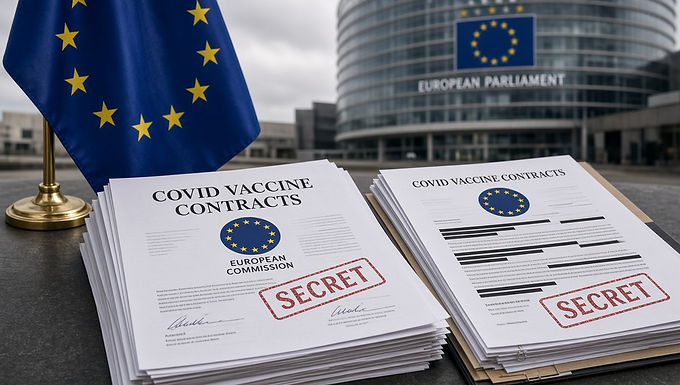
LUXEMBOURG (CN) — The European Union’s secret Covid-19 vaccine contracts landed back before the bloc’s highest court on Wednesday, as the European Commission fought to keep parts of the pandemic-era agreements hidden from the public.At a hearing, the Commission asked the Court of Justice of the European Union to overturn a 2024 ruling by a lower court that found it had not justified redacting parts of its Covid-19 vaccine purchase contracts and ordered broader disclosure.Commission representatives Antonios Bouchagiar, Alessandro Spina and Miguel Burón Pérez told the judges that the agreements were negotiated under intense pandemic pressure and contain commercially sensitive provisions that were never meant to be made public.“These are not standard contracts with standard clauses,” one Commission representative said. “They are long and complex contracts.”The Commission argues that several of the contested provisions are at the core of the vaccine agreements, including liability clauses, rules on the receipt or donation of doses, and definitions such as “wilful misconduct” and “best reasonable efforts”. These terms were crafted during delicate negotiations with pharmaceutical companies and later redacted to protect their commercial interests.According to the Commission, publishing these clauses could harm the commercial interests of vaccine manufacturers, in particular by revealing indemnification terms that could help parties bring product-liability claims. Officials also defended keeping the names of the EU’s vaccine negotiation team secret, on the grounds that the identities constitute protected personal data and that disclosure could expose them to external pressure or harassment.That position drew sharp questions from the bench.“Normally I wouldn’t intervene, but do you really mean that?” asked Judge Koen Lenaerts, the Court’s president. “Does the public not have an obvious interest in verifying the neutrality of the officials dealing with such an important matter as the one at issue here? I mean, it should be obvious that there is no conflict of interest. It should be obvious to the entire public that there is no conflict of interest. So you are saying that the mere interest in verifying impartiality is not enough, but that is the very essence of transparency.”Commission lawyer Bouchagiar replied: “We should clarify,” he said. “We do not doubt that access to documents … can, in the first place, be linked to the public interest in transparency.”The applicants’ lawyers, however, rejected the Commission’s position and framed the case as a test of democratic accountability during a public-health crisis. Among the challengers are the European legislators Margrete Auken and Tilly Metz, along with thousands of citizens. Their lawyers – M. Nuytten, M.R. Gherghinaru and A. Durand – appear in the court records in accordance with the Court’s convention of listing lawyers by first name and surname.“In a union based on representative democracy, access to documents is not a procedural luxury. It is one of the essential mechanisms through which accountability becomes real and effective,” Gherghinaru told the Court.“Transparency is not an abstract ambition. It is a constitutional value expressly enshrined in the Treaties. It enables EU citizens to understand how decisions are taken, to scrutinise the exercise of public power and to hold institutions to account,” she added.The applicants said the Commission had relied on speculation rather than concrete evidence to justify secrecy, and argued that vaccine manufacturers already face potential liability under EU product-liability law regardless of whether the contracts are public. They also challenge the refusal to publish the names of the vaccine negotiation team, saying citizens have a legitimate interest in knowing who negotiated deals involving billions of public funds and whether those individuals had potential conflicts of interest.They further dismissed the Commission’s suggestion that any potential misconduct could instead be investigated by bodies such as the European Anti-Fraud Office or the European Public Prosecutor’s Office, noting that the Anti-Fraud Office operates within the Commission and cannot replace public access to the documents.In 2020, as Covid-19 spread across Europe, the European Commission took the lead in securing vaccines for all EU member states. Acting as a joint buyer for the bloc, it concluded advance purchase agreements with several pharmaceutical companies and committed billions of euros in public funds to guarantee early access to doses once the vaccines were authorised.These agreements quickly triggered a battle over transparency. The negotiations also attracted scrutiny of text messages exchanged between Commission President Ursula von der Leyen and Pfizer CEO Albert Bourla during the pandemic procurement talks, which journalists and lawmakers later requested under EU transparency rules, but which the Commission said it could not locate. Meanwhile, lawmakers and thousands of citizens filed access-to-documents requests seeking fuller disclosure of the vaccine contracts and related records in order to understand how the deals were structured and what safeguards were in place for billions of public funds.In July 2024, the EU’s General Court handed the applicants a partial victory. The judges said the Commission had not sufficiently explained why several passages in the vaccine contracts should remain secret and ordered broader access to parts of the agreements and related documents.The Commission quickly appealed to the Court of Justice of the European Union, arguing that the lower court had misinterpreted the bloc’s transparency rules and had failed to properly weigh the commercial interests of the pharmaceutical companies involved.During Wednesday’s hearing in Luxembourg, the judges pressed both sides on issues that are likely to shape the outcome of the appeal. Much of the discussion focused on the legal threshold for refusing access to documents under EU transparency law, and what institutions must demonstrate to prove that disclosure would create a concrete and foreseeable risk of harm.The panel – chaired by Lenaerts and including Judges Küllike Jürimäe, Zoltán Csehi, Fredrik Schalin and Miroslav Gavalec – also examined where the line should be drawn between public oversight and business secrets when EU institutions negotiate large contracts with private companies. The judges pushed the parties to assess how far transparency obligations should extend when sensitive negotiations are conducted on behalf of the entire bloc.The case now moves to the next stage of the procedure. Advocate General Athanasios Rantos is scheduled to deliver his opinion on 11 June, after which the judges will deliberate before issuing a final ruling, probably later this year. The Court’s decision will determine whether the European Commission can continue to protect key parts of the vaccine contracts or whether it must open more of the pandemic deals to public scrutiny.
bottom of page