


At least 15,000 babies were supposed to have been born in Denmark.
By Jeanne A. Rungby, MD, specialist.

The Danish Regions have observed a decrease of at least 5,000 live births per year in 2022, 2023 and 2024 compared to expectations. It is grim news that the mainstream media has cleverly avoided debating. Denmark has approximately 6 million inhabitants.
The last few months have brought new scientific evidence of the possible impact of mRNA vaccines on fertility in a number of countries. The results of these studies are described further down in the article.
First, a little background knowledge:
Background for the approval of Pfizer's "vaccine" for pregnant and fertile women.
It is important to be clear that the clinical trials used to approve the COVID-19 vaccines excluded pregnant women.
The question is which studies actually formed the basis for the approval of Pfizer's COVID-19 mRNA "vaccine" for pregnant women and young people of childbearing age.
Studies on reproductive and developmental toxicity must clarify whether the substance has an impact on the ability to reproduce and on the health and fertility of the offspring.
In other words, had the authorities ensured that the new mRNA COVID-19 vaccine could not harm the ability to have children in both current and future generations before approval?
In response to the question ( 1 ) about which specific reproduction studies are the basis for Minister of Health Sophie Løhde rejecting the risk of a possible change in the genetic makeup of sperm and egg cells, the Danish Medicines Agency (Jakob Lundsteen, case no. 2024024182, 2024-03-13) responds that "the preclinical data behind the approval included reproduction and toxicology studies on animals."
The Danish Medicines Agency referred here to a single study by Bowman CJ et al. This was a preclinical study paid for and conducted by Pfizer/BioNTech (the vaccine manufacturer) on 44 female Wistar rats ( 2 ), a rodent species that is unsuitable for toxicological studies in relation to human physiology. An additional, more relevant species (monkey or Chinese hamster) should have been chosen for toxicity studies on developmental issues.
Pfizer did not include germline integration studies in this study and therefore did not exclude the possibility of mutagenic effects in either the mother or the offspring. The rat litters were sacrificed after the breeding period had ceased. No long-term studies of offspring behavior, development, germline or fertility were conducted.
Male rats were not studied and data on male rat fertility were unknown prior to approval.
This is therefore a very thin basis for approval. The study was conducted by the manufacturer, who to a large extent must be said to have a conflict of interest in relation to the result.
But the story does not stop here.
Another later access to documents (3) has since revealed that the conclusions in the above-mentioned rat study had been manipulated, as it revealed that the rat fetuses/offspring actually showed signs of malformations.
The report read:
"A combined fertility and developmental toxicity study in rats showed an increased incidence of supernumerary lumbar vertebrae in fetuses from COMIRNATY-treated female rats."
Bone anomalies are one of the standard measures of the danger of a new substance to the offspring in connection with the risk of malformations from new medications given during pregnancy.
Another very crucial result, which was also omitted from the Bowman et al article, refers to fertilized eggs that did not implant in the uterus . There was a doubling of fertilized eggs that did not implant in the uterus in the vaccinated rats. This difference between vaccinated and unvaccinated rats was statistically significant and could not be attributed to chance. Therefore, this study suggests that the Pfizer Covid-19 vaccine reduces a woman's chances of becoming pregnant. There was thus clear evidence that Comirnaty increased the risk of reducing women's ability to have children.
Despite this scientific evidence to the contrary, the FDA and Pfizer falsely claimed that these vaccines had no effect on fertility:
The conclusion of the study was as follows: “There were no effects of BNT162b2 on female mating behavior, fertility, or any ovarian or uterine parameters, nor on embryo-fetal or newborn survival, growth, physical development, or neurofunctional development until the end of the lactation period.”
That wasn't true.
It was thus foreseeable that these vaccines carried a risk of affecting fertility in women. It is therefore clear that the COVID-19 vaccines (Comirnaty) were recommended for pregnant women without any real scientific basis.
Existing safety assessments of COVID-19 vaccination in humans, particularly in the early stages of pregnancy, have been limited to studies that observe recorded harms after the vaccines were approved for pregnant women and young people of reproductive age. These studies are called post-marketing studies. Such post-marketing studies are not sufficient as a basis for retroactive approval. This should be obvious.
In addition, Pfizer was allowed to make a significant shift in the manufacturing method of the vaccine from the pure PCR-based manufacturing, which was expensive but without risks for plasmid DNA, SV40 promoter, nanolipids and endotoxins, to a manufacturing process based on the cultivation of E-coli bacteria without Pfizer being required to conduct new phase 3 trials based on this E-coli method.
This process shift can be difficult to understand the significance of.
In February 2024, I wrote the following to Minister of Health Sophie Løhde (4):
“ Process 1” involves the synthetic production of mRNA as a drug substance from a DNA template generated synthetically via a PCR method. This manufacturing process was used in the clinical trials that formed the basis of the application for regulatory approval.
The vaccine that has been brought to the market is not manufactured using a process identical to “process 1”.
The product on the market is manufactured using process 2, which involves mass production of a DNA template using a plasmid that is amplified and purified from genetically modified E. coli bacteria (intestinal bacteria). These two processes and the associated risks are not identical and should therefore be subject to separate GMP (Good Manufacturing Practice) ”
It is not stated anywhere in the rat article by Bowman et al which manufacturing process, i.e. process 1 or process 2, is the basis for the study on the pregnant rats that forms the basis for the Danish Medicines Agency's approval. If such a study is to form the basis for an approval of the commercial product, in this case Comirnaty, then it is crucial that it is the same manufacturing process.
The legally required consideration of the precautionary principle in relation to fertile young people, pregnant women, fetuses and children therefore appears not to have been complied with.
Fertility today.
Birth complications and fertility in Denmark?
Bleeding during and after childbirth has increased dramatically, as documented by mandatory reporting from maternity wards. Many more initiatives to combat postpartum (after childbirth) bleeding have been registered in recent years, and the authorities have decided that pathological bleeding is now defined as 1500 ml against the previous 1000 ml. This is because the number of women bleeding 1000 ml or more has exploded in recent years. According to the WHO, bleeding during childbirth is one of the largest causes of death for women in the world.
The annual report from the Danish Quality Database for Births for 2024 reported that bleeding during childbirth is a well-known and significant cause of maternal mortality ( 5 ). The definition of “severe postpartum hemorrhage” has previously been set nationally and internationally as ≥ 1000 ml. However, the indicator has recently been increased to 1500 ml. The proportion of women with registered bleeding of both >1000 ml and >1500 ml in connection with childbirth has been steadily increasing over the past 10 years. However, there is a significant increase in 2022. See Figure 1.

Figure 1 (5) shows a significant increase in the proportion of women with a measured blood loss of more than 1500 ml. in connection with childbirth in Denmark.
The increased blood loss generally has major negative consequences for the woman and her partner's experience of childbirth. It complicates, delays or prevents breastfeeding. Breast milk, especially the first colostrum, is of great importance for the child's immune system and for the attachment between mother and child. Low blood counts affect the woman's well-being and recovery in the early postpartum period.
Declining birth rates.
The Danish Quality Database's annual report from 2023 describes a surprising drop in the birth rate of approximately 5,000 births in 2022 compared to 2021 ( 6 ). This drop was repeated in 2023 and 2024. This drop was unexpected, as a large increase was expected due to the large birth cohort of women born 25-35 years ago. An upward curve in birth rates had been expected in recent years. On the other hand, there was a pronounced decline in fertility from 2022 onwards. The estimated shortage of approximately 15,000 babies is therefore low, as it assumes an unchanged straight curve, without taking into account the large cohorts starting in these years.

Figure 2. From Statbanken.dk It is clear that there was a significant decrease in 2022 and a steady decrease thereafter.
The birth rate has not only fallen in Denmark. Europe is facing a historic decline in fertility of around 15% from the first quarter of 2022, with a worsening in the first quarter of 2023 and a steady decline in fertility rates since then, as shown in Figure 3 below ( 7 ).

An investigation into such a pronounced decline should necessarily go back 9 months.
April to August 2021 was the period when the majority of the reproductively active population of Europe received 2 doses of the COVID-19 vaccinations.
It is clear that this decline is not proof of causation, but the reasons for a decline with such an impact should certainly be investigated without excluding these new massive measures that the COVID-19 vaccines represent.
Fertility in the World.
Sally Clark, Bachelor of Science in physiology and pharmacology, has observed population trends, including birth rates, in several countries. Population data for April 2025 have recently been published for France, Macau, Hong Kong, Malaysia, Japan (2024), and Taiwan. All countries show a worrying trend, especially in terms of birth rates ( 8 ).
Sally Clark writes:
“Births reflect societal changes, life pressures and values, and fertility (women’s ability to have children). There is ample information linking COVID-19 vaccines to fertility issues, and there is a world of difference between women who choose not to have children and women who are unable to conceive and bear children! If these losses are due to infertility and the loss of the ability to carry and bear a healthy child, then the alarm must be raised and measures must be taken to counter and reverse this trend. If not, humanity faces extinction!”
Below are two figures from Canada and Japan. These are populations of approximately 40 million and 124 million respectively, all of which have high vaccination coverage for COVID-19 vaccines.
In this context, it is important to remember that it has been the WHO's goal since 1987 to sterilize through vaccines ( 9 ).


Fertility in women and new research findings.
A study by Dr. Josh Guetzkow and colleagues analyzed over 220,000 pregnancies in Israel from 2016 to 2022 ( 11 ). The study found that mRNA COVID-19 vaccination during weeks 8–13 of pregnancy was associated with a higher than expected rate of fetal loss, including miscarriages, abortions, and stillbirths. These data suggest a possible association between the vaccine and increased pregnancy loss during this specific time frame, but further research is needed to confirm causality and the underlying mechanisms. The authors of this study are not employed by Pfizer and declare no conflicts of interest.
A 33% decrease in vaccinated people.
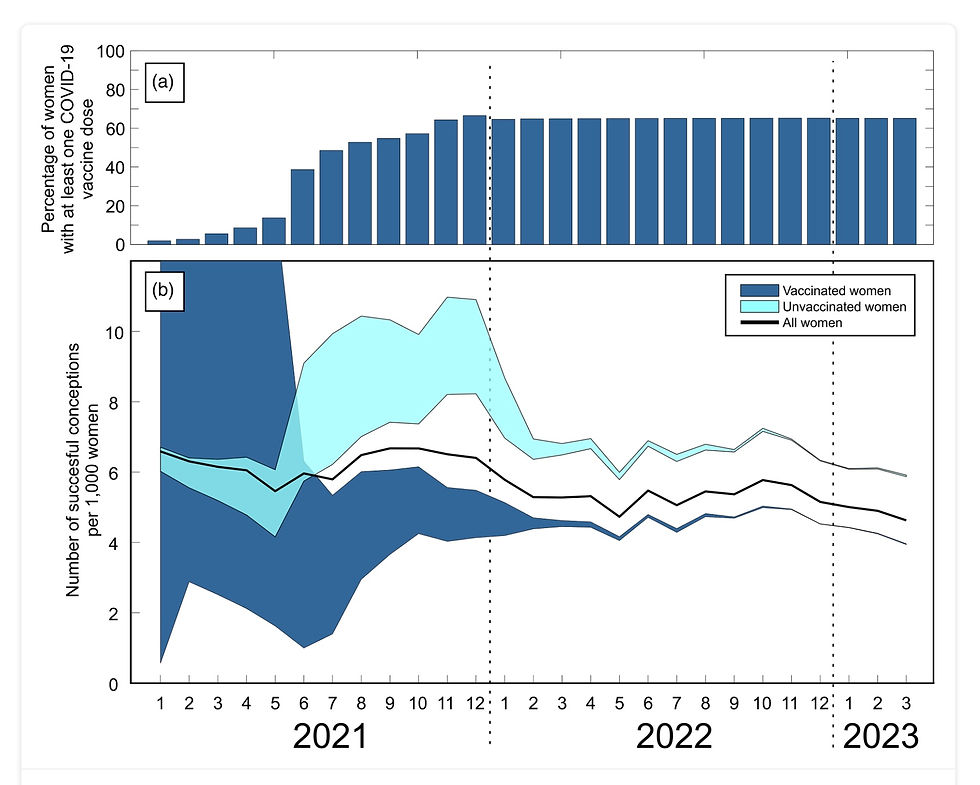
Another recent study by Manniche et al has shown a significant difference in the rate of pregnancies resulting in live births with a decrease of approximately 33% in the group of COVID-19 vaccinated women aged 18 - 39 before delivery compared to unvaccinated ones. See Figure 6 ( 12 )
37 pregnancy-related adverse events after COVID-19 vaccination.
An article from February 8, 2025 by James Thorp (13), presents a retrospective analysis of adverse events associated with COVID-19 vaccination during pregnancy based on data from the CDC/FDA Vaccine Adverse Event Reporting System (VAERS) from January 1, 1990 to April 26, 2024. The study identified significant safety signals for 37 pregnancy-related adverse events after COVID-19 vaccination, including miscarriage, fetal loss, preterm birth, preeclampsia, and neonatal complications such as respiratory distress and seizures. These were compared with adverse events from influenza and other vaccines. Proportional Reporting Ratios (PRR) showed elevated risks with PRRs ranging from 5.37 to 499 (mean 69.3), well above the CDC/FDA threshold for safety concerns (PRR ≥ 2). All p-values were ≤ 0.001, indicating strong statistical significance. The authors argue that the US government, medical organizations, and pharmaceutical companies have misrepresented the safety of COVID-19 vaccines during pregnancy and call for an immediate global halt to their use in pregnant women. They draw parallels with diethylstilbestrol (DES), a historical case in which a drug promoted to prevent pregnancy loss caused multigenerational harm, suggesting potential long-term risks of COVID-19 vaccines. The study questions the transparency of safety monitoring and argues that the promotion of vaccines during pregnancy prioritizes narrative over science. The authors conclude that the high rates of adverse events warrant a halt to COVID-19 vaccination during pregnancy.
Antibodies to phosphatidylethanolamine.
Antibodies to phosphatidylethanolamine are the most common antiphospholipid antibodies detected in patients with recurrent miscarriages within the first 10 weeks of pregnancy. A 2024 study ( 14 ) showed that antibody concentrations to phosphatidylethanolamine after vaccination were significantly elevated compared with prevaccination levels ( p = 0.008). This is of concern and the authors consider whether cross-reactivity occurs such that antibodies to spike protein also react to phosphatidylethanolamine. Further studies are needed to clarify this association.
Menstrual disorders.
COVID-19 vaccines continue to be recommended for women of childbearing age in many countries to protect against COVID-19. Many early and late reports have noted menstrual irregularities following administration of COVID-19 vaccines using mRNA and adenovirus vectors ( 15 , 16 ).
A 2022 online survey found that menstrual cycle changes in women who received COVID-19 vaccines were widespread ( 16 ). The study found that 56% of women experienced changes in their menstrual cycle after receiving two COVID vaccines.
The study involved more than 39,000 adults aged 18 to 80 from around the world who had received two doses of COVID vaccine . Participants were vaccinated with vaccines from Pfizer, Moderna, AstraZeneca, Johnson & Johnson and Novavax.
A surprisingly large proportion, 42%, of study participants said they experienced heavier bleeding during their menstrual cycle after receiving the COVID vaccine. 14% of participants experienced unusually light menstrual cycles, and 44% reported no change.
The authors speculate on the mechanism, although unknown, by which the vaccine may cause menstrual symptoms. They consider it likely to be the result of immune-mediated vaccine-induced platelet deficiency (thrombocytopenia). This speculation is based on the fact that many other vaccines, including measles-mumps-rubella (MMR), hepatitis A and B, diphtheria-tetanus-acellular pertussis (DTaP), chickenpox, and even influenza, have previously been linked to vaccine-induced thrombocytopenia.
Changes in the menstrual cycle do not necessarily mean infertility, but they do represent a danger signal.
Such a high incidence of menstrual disorders, combined with the weak basis for approving COVID-19 vaccines for young and fertile adults, as discussed above, should have prompted authorities to immediately halt COVID-19 vaccination, in line with the precautionary principle. Existing data and the scientific basis for the pandemic and the effectiveness of vaccines were poor and clearly manipulated ( 17 ).
Examination of immature egg cells.
A recent study from March 2025 by Kamaran and colleagues examined the effects of mRNA COVID-19 vaccines on ovarian histology (under the microscope) and reserve egg reserve in female Wistar albino rats (18).
Rats given an intramuscular injection of a Pfizer-BioNTech COVID-19 mRNA vaccine – at a dose similar to that given to humans – experienced a >60% reduction in the number of immature egg cells (primordial follicles), which are the basis for future fertility (p < 0.001). The inactivated vaccine (CoronaVac) also caused losses, but to a lesser extent.
These described damages affect an egg supply that cannot be restored. The pool of immature eggs is limited and non-regenerative — women are born with all the eggs they will ever have. Destruction of this pool is irreversible and leads to permanent fertility loss if transferred to humans.
The study also showed that Anti-Müllerian hormone (AMH) levels plummeted. AMH, a hormone that reflects ovarian reserve, decreased significantly in the mRNA group – both in serum and in ovarian tissue (p < 0.001).
Lower AMH is associated with poor fertility outcomes and earlier menopause. The study also found increased cell death and elevated inflammatory biomarkers including caspase-3 (a cell death enzyme) and inflammatory markers such as TGF-β1 and VEGF in the vaccinated rats. These biomarkers are associated with ovarian atresia (shrinkage), fibrosis (scar tissue) and long-term tissue damage.
The mRNA vaccines caused the worst damage:
Fewer growing follicles (primary, secondary, antral, preovulatory)
· Multiple dying follicles (atretic)
· Greater reductions in hormone markers of fertility.
If these findings also apply to humans, it has far-reaching implications for global fertility. This type of damage – to a woman’s lifelong egg supply – is biologically irreversible.
The authors discuss the need for further research to understand the long-term implications of these changes, particularly whether they are reversible or affect fertility. The findings raise questions about the impact of vaccines on reproductive health, but the study is limited to rats, and its application to humans remains uncertain.
The importance of Nanoparticles and Nanolipids in egg maturation.
In mammals (including humans), the ovarian reserve, or the limited number of immature oocytes (primordial follicles) that a woman has available throughout her reproductive life, is established around birth. Oocytes continuously develop from immature to mature oocytes through a series of intermediate stages, all of which can be negatively affected by nanoparticles. It has been shown that the formation of immature oocytes can be disrupted by a variety of nanoparticles (19) , such as zinc oxide nanoparticles (ZnO-NP). Specifically, the ovaries of offspring from mothers (mice) exposed to ZnO-NP by injection from approximately 14 days before conception to 3 days after birth showed increased DNA damage in the immature oocytes that underwent apoptosis (cell death), leading to reduced formation of mature oocytes ( 20 ). Furthermore, the authors confirmed that ovaries from offspring exposed to ZnO-NPs contained fewer oocytes overall. These findings suggest that prenatal exposure to ZnO-NPs may reduce ovarian reserve and the transition from immature to mature oocytes (20 ).
The results of this and other studies suggest that certain types of nanoparticles affect pre- and postnatal formation of the egg pool both in vitro and in vivo ( 19 ). Many studies have been conducted on experimental animals, showing that nanoparticles (NP) can damage the development of egg cells and thus the ability to have children. The size, shape, surface, combinations and charge of the nanoparticles have an impact on different stages of egg maturation (Figure 7). Among other things, increased occurrence of inflammatory markers in the ovaries has been seen. Nanoparticles are not only found in vaccines. They are found to a large extent in creams, including sunscreens, and in foods ( 19 , See PDF format in the reference list for full text).

Conclusion:
The basis for the approval of the COVID-19 vaccines was thin and manipulated.
Many new scientific studies suggest a link between declining fertility and these vaccines.
Regardless of the cause, declining fertility is an alarming factor for humanity.
It should therefore be investigated immediately, without ruling out major population-related initiatives such as the COVID-19 vaccines simply because it is not publicly permitted to question them.
Fertility, including sperm quality, in men in connection with the COVID-19 vaccines is at least as important as women's fertility. For reasons of scope, they are not included in this blog.
References.
1. Second letter to the Danish Minister of Health and response from the Danish Medicines Agency. https://activecivilian.com/activities/f/second-letter-to-the-danish-government
2. Lack of effects on female fertility and prenatal and postnatal offspring development in rats with BNT162b2, an mRNA-based COVID-19 vaccine . Bowman C et al. https://www.sciencedirect.com/science/article/pii/S0890623821000800?via=ihub
4. Response from the Danish Medicines Agency to questions to the Minister of Health regarding process 2. https://www.dropbox.com/scl/fi/3tx0s3r222ked3kp4gq4a/Respons-from-lmst-Jakob.pdf?rlkey=snldvle1mwxnikynkmkjdfb0p&e=1&dl=0
5. Danish Quality Database for Births, Annual Report 2024. https://www.sundk.dk/kliniske-kvalitesdatabaser/dansk-kvalitesdatabase-for-foedsler-dkf/viden/
6. Danish Quality Database for Births, Annual Report 2023. https://www.sundk.dk/media/mediefnz/e8d557a3cdf646f695e0b55cfccda6e4.pdf
11. Observed-to-Expected Fetal Losses Following mRNA COVID-19 Vaccination in Early Pregnancy. Guetzkow J et al. https://www.medrxiv.org/content/10.1101/2025.06.18.25329352v1
12. Rates of successful conceptions according to COVID-19 vaccination status: Data from the Czech Republic. Manniche V et al. https://journals.sagepub.com/doi/10.1177/09246479251353384
13. Are COVID-19 Vaccines in Pregnancy as Safe and Effective as the Medical Industrial Complex Claim? Part I. Thorp J et al. https://publichealthpolicyjournal.com/are-covid-19-vaccines-in-pregnancy-as-safe-and-effective-as-the-medical-industrial-complex-claim-part-i/
14. Comparison of anti-phospholipid antibody titers before and after SARS-CoV-2 mRNA vaccination in hospital staff. Hisano M et al. https://www.sciencedirect.com/science/article/pii/S2590136224001128
15. Menstrual Symptoms after COVID-19 vaccine: A Cross Sectional Investigation in the MENA Region. Muhaidat A et al. https://www.tandfonline.com/doi/full/10.2147/IJWH.S352167
16. Investigating trends in those who experience menstrual bleeding changes after SARS-CoV-2 vaccination. Lee KMN et al. https://www.medrxiv.org/content/10.1101/2021.10.11.21264863v2
18. Impact of mRNA and Inactivated COVID-19 Vaccines on Ovarian Reserve. Karaman E et al. https://www.mdpi.com/2076-393X/13/4/345
19. Ovarian toxicity of nanoparticles. Santacruz-Marques R et al.
Exposure to Zinc oxide nanoparticles during pregnancy induces oocyte DNA damage and affects ovarian reserve of mouse offspring. Zhai QY. https://www.aging-us.com/article/101539/text20 .
About Sally Clark:
Sally Clark's academic qualifications include BSc (Bachelor of Science, majoring in physiology and pharmacology) and BOccThy (Hons 1), both in 1994 and both from The University of Queensland Australia. She has completed certificate level training in Nutrition with Nutrition Network (South Africa) focusing on low carbohydrate nutrition between 2020 and 2021. An Ironman Triathlon finisher (2007), she has a special interest in nutrition and wellness, and particularly diabetes management. She has moderated a Philippines on-line ketogenic diet support group (Ketogenics PH) since its inception in 2017.
Sally works as an Engineering Manager / Engineering Consultant for Kingsford Environmental Phils., Inc and Kingsford Environmental Hong Kong Ltd. which are waste water engineering companies. She has worked with these companies first in Hong Kong starting in 1995 and then in the Philippines starting in 1997.


Comments